
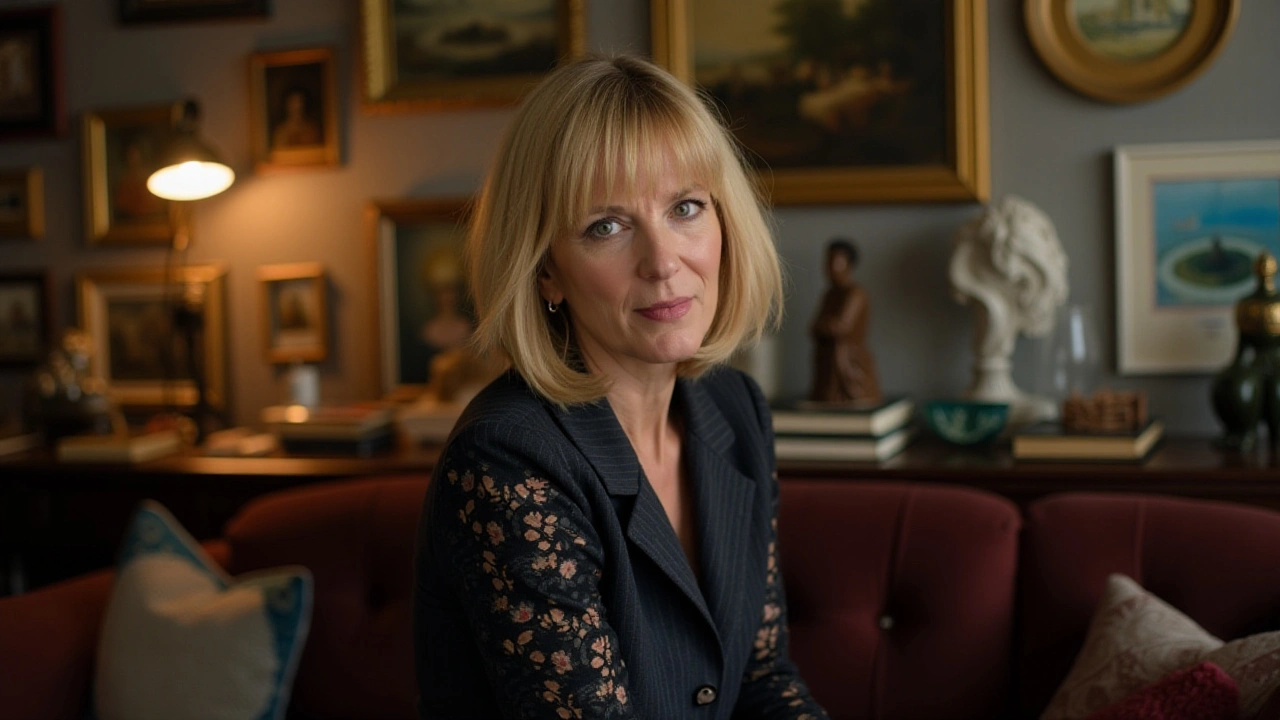
Marianne Faithfull: A Timeless Influence in British Pop Passes at 78

Marianne Faithfull: A Timeless Influence in British Pop Passes at 78
Nkosana Bhulu Feb, 1 2025

The Early Years and Rise to Fame

Marianne Faithfull was a singular figure in the world of British pop, her remarkable journey beginning in Hampstead, London, where she was born in December 1946. From the outset, her life was a tapestry woven with art, culture, and potential. Faithfull's early exposure to the arts came from her parents, with a father who was a professor and a mother who was a baroness and ballet dancer. This rich cultural upbringing undoubtedly laid the groundwork for what would become a groundbreaking career in music and acting. At the tender age of 17, Faithfull burst into the music scene with her haunting rendition of 'As Tears Go By.' The song, penned by Mick Jagger and Keith Richards, catapulted her into the limelight, instantly making her a household name. This track, with its gentle melody and melancholic lyrics, resonated with audiences and established her as a major player in the British Invasion of the 1960s.

A Relationship That Shaped Musical History

Faithfull's life off-stage was as high-profile and influential as her career. Her relationship with Rolling Stones' frontman Mick Jagger, commencing in 1966, was a defining chapter in her life. The couple's relationship was a tumultuous affair but one that inspired several timeless tracks. She was often seen as Jagger's muse, with songs like 'She Smiled Sweetly,' 'Let's Spend the Night Together,' and 'Sister Morphine' bearing her lyrical contributions and reflective of their passionate liaison. While their relationship ended in the 1970s, the indelible mark that Faithfull left on Jagger's songwriting is undeniable, with themes of love, loss, and rebellion intertwined in the melancholic melodies.

Struggles and Triumphs

The 1970s proved to be a turbulent decade for Marianne. Her battle with substance abuse was a struggle that brought her to the brink of homelessness and severely dented her earlier successes. The unresolved personal turmoil and challenges took a toll on her professionally, resulting in a period where her artistic output diminished. However, Marianne Faithfull was not one to be defeated easily. Her remarkable comeback in 1979 with the album 'Broken English' was a testament to her resilience and artistic evolution. This album was not just a return; it was a redefinition. Featuring starkly autobiographical lyrics and a raw, edgy sound, the album received critical acclaim and signaled a triumphant return to the music world. It was this period that solidified her status as a rock icon, her new husky vocal style becoming her signature. Faithfull received a Grammy nomination for 'Broken English,' and the album's influence is still felt today.

Reinvention and Legacy

In a career spanning several decades, Faithfull released over 20 albums, each time reinventing herself while retaining the dark, brooding allure that fans found so captivating. Beyond music, she explored acting, with notable roles in films like 'The Girl on a Motorcycle' and stage productions of 'Hamlet' and 'Three Sisters' by Chekhov. This artistic versatility only enhanced her reputation as a multi-talented trailblazer.

Personal Battles and Triumphs

Faithfull's personal life was a testament to her indefatigability. She faced numerous health challenges, including a breast cancer diagnosis in 2006, which she battled with characteristic courage. More recently, she contracted COVID-19 in 2020, a disease that added another chapter to her life of struggles and resilience. Through these trials, Faithfull maintained a positive outlook, pouring her experiences into her art and continuing to create until the very end.

The Impact of an Icon

Marianne Faithfull leaves behind a legacy rich with triumph and influence. Her distinct voice, imbued with emotion and life experiences, has inspired countless musicians and artists. Faithfull's indomitable spirit and resilience made her not just a figure of celebrity but a beacon for women in rock and popular music to follow. Her story, from a Catholic schoolgirl to an international icon, is one of strength, survival, and an enduring impact that continues to influence the music industry today.

Tributes to a Legend

As news of her passing spreads, tributes are pouring in from fans and celebrities alike, each honoring her significant contributions to music and art. Marianne Faithfull's journey, both personal and professional, has resonated with many, leaving behind a legacy that is as timeless as it is inspirational. Her music and art were a reflection of her life - tumultuous, passionate, and ultimately resilient, and she was a woman who lived life on her own terms.

19 Comments
  • Image placeholder
    Dinesh Kumar February 2, 2025 AT 21:06
    Marianne was pure magic with a cigarette in one hand and a broken heart in the other. That voice? Like velvet dipped in smoke and regret. She didn't sing songs-she exorcised demons. And honestly? We all needed her to. 💥
  • Image placeholder
    Sanjay Gandhi February 4, 2025 AT 10:50
    I still remember the first time I heard 'Broken English'-it was 2003, I was 16, living in a tiny flat in Jaipur with no AC and a broken radio. But her voice? It cut through the static like a knife. She wasn't just a singer-she was the sound of survival. 🕯️
  • Image placeholder
    Srujana Oruganti February 5, 2025 AT 09:52
    Honestly? She got too much credit. Jagger wrote the songs. She just cried into the mic. And the 'resilience' narrative? Cute. It's just what happens when you're famous and then you're not.
  • Image placeholder
    fatima mohsen February 6, 2025 AT 10:20
    This is why Western pop culture is so toxic. A woman gets famous, ruins her life, then gets praised for it? No. We need role models who stay strong, not ones who collapse into heroin and then call it 'art'. 😒
  • Image placeholder
    Pranav s February 8, 2025 AT 06:50
    she was hot in the 60s but like... why is everyone acting like she invented rock? i mean come on
  • Image placeholder
    Ali Zeeshan Javed February 10, 2025 AT 06:11
    Look, I get the drama. But let’s not forget-Marianne was one of the first women to take control of her narrative after being used as a muse. She didn’t just survive the 70s-she turned her pain into poetry. That’s not tragedy. That’s transcendence. 🙏
  • Image placeholder
    Žééshañ Khan February 10, 2025 AT 21:03
    The cultural significance of Marianne Faithfull’s artistic evolution cannot be understated. Her transition from pop ingenue to avant-garde vocal interpreter represents a paradigm shift in the socio-aesthetic landscape of late 20th century British music.
  • Image placeholder
    ritesh srivastav February 11, 2025 AT 23:12
    Oh please. She was just another rich white girl who got lost in the 60s. Meanwhile, real artists in India were making music that actually meant something. This whole tribute thing is just colonial nostalgia.
  • Image placeholder
    sumit dhamija February 12, 2025 AT 00:49
    I don’t know why people romanticize addiction. She had privilege. She had access to therapy. She had fame. And yet she chose chaos. That’s not bravery. That’s self-indulgence.
  • Image placeholder
    Aditya Ingale February 12, 2025 AT 04:03
    Man. I watched her on that 2010 documentary where she sang 'The Ballad of Lucy Jordan' and I just... I cried. Not because she was broken. Because she was still standing. Still singing. Still terrifyingly alive. That’s the kind of power you don’t learn in school. That’s earned.
  • Image placeholder
    Aarya Editz February 13, 2025 AT 14:24
    There is a profound truth in her voice: that beauty is not the absence of damage, but the clarity with which one speaks through it. Her art was not about perfection-it was about presence. And presence, in a world obsessed with performance, is revolutionary.
  • Image placeholder
    Prathamesh Potnis February 15, 2025 AT 11:13
    Marianne Faithfull was a significant cultural figure whose contributions to music and film reflect the evolving role of women in the arts during the latter half of the 20th century.
  • Image placeholder
    Sita De savona February 16, 2025 AT 18:15
    She was the original ‘I don’t care what you think’ energy and I respect it 😌
  • Image placeholder
    Rahul Kumar February 17, 2025 AT 01:12
    i still have her vinyl of 'Broken English' in my room. it’s scratched but i play it anyway. it feels like talking to someone who’s been through hell and still made coffee in the morning.
  • Image placeholder
    Shreya Prasad February 17, 2025 AT 03:46
    Marianne Faithfull’s enduring legacy lies in her ability to transform personal adversity into universal artistic expression, thereby contributing significantly to the evolution of contemporary popular music.
  • Image placeholder
    GITA Grupo de Investigação do Treinamento Psicofísico do Atuante February 18, 2025 AT 00:56
    Actually, I think her later work was overrated. The rawness was just a product of vocal degradation. She lost her range, and people mistook that for depth. It’s not profound-it’s physiological.
  • Image placeholder
    Nithya ramani February 19, 2025 AT 22:17
    She never gave up. Even when the world turned its back, she kept singing. That’s the kind of strength we should all try to have.
  • Image placeholder
    anil kumar February 21, 2025 AT 14:10
    You ever notice how the most broken people make the most beautiful art? It’s like their soul’s cracked open and the light pours out in the wrong places-until you realize, that’s where the music lives. She didn’t sing notes. She sang scars.
  • Image placeholder
    shubham jain February 23, 2025 AT 14:03
    She was a muse. Not a musician.
Write a comment